Old vs new tax regime FY 2026-27: which saves more?
Worked salary examples from ₹8 lakh to ₹30 lakh, the deductions you need for the old regime to win, and a simple way to decide for tax year 2026-27.
Every April your employer asks which regime you want for TDS, and you get one more chance when you file your return. For FY 2026-27, which the new Income-tax Act, 2025 calls tax year 2026-27, the new regime is the default. You only pay old regime rates if you opt out. Budget 2026 did not change the slabs for either regime, so the comparison below should hold for the whole year.
All the figures here come from our income tax calculator. It checks both regimes side by side and runs in your browser, so your salary never leaves your device.
The two regimes at a glance
| Taxable income | New regime | Old regime |
|---|---|---|
| Up to ₹2.5 lakh | Nil | Nil |
| ₹2.5 to 4 lakh | Nil | 5% |
| ₹4 to 5 lakh | 5% | 5% |
| ₹5 to 8 lakh | 5% | 20% |
| ₹8 to 10 lakh | 10% | 20% |
| ₹10 to 12 lakh | 10% | 30% |
| ₹12 to 16 lakh | 15% | 30% |
| ₹16 to 20 lakh | 20% | 30% |
| ₹20 to 24 lakh | 25% | 30% |
| Above ₹24 lakh | 30% | 30% |
- Standard deduction: ₹75,000 in the new regime, ₹50,000 in the old.
- Rebate: new regime up to ₹60,000 when taxable income is ₹12 lakh or less, so tax is nil. Old regime up to ₹12,500 when taxable income is ₹5 lakh or less.
- Deductions: the old regime lets you claim 80C (₹1.5 lakh), HRA, home loan interest on a self-occupied house (₹2 lakh), 80D, extra NPS under 80CCD(1B) and professional tax. The new regime allows almost none of these.
- Cess: 4% on top in both. Surcharge applies above ₹50 lakh, capped at 25% in the new regime.
If you claim nothing: the new regime wins at every salary
| Salary | New regime tax | Old regime tax | Deductions needed to break even |
|---|---|---|---|
| ₹8 lakh | ₹0 | ₹65,000 | ₹2,50,000 |
| ₹10 lakh | ₹0 | ₹1,06,600 | ₹4,50,100 |
| ₹12 lakh | ₹0 | ₹1,63,800 | ₹6,50,100 |
| ₹12.75 lakh | ₹0 | ₹1,87,200 | ₹7,25,100 |
| ₹15 lakh | ₹97,500 | ₹2,57,400 | ₹5,43,800 |
| ₹18 lakh | ₹1,50,800 | ₹3,51,000 | ₹6,41,700 |
| ₹20 lakh | ₹1,92,400 | ₹4,13,400 | ₹7,08,400 |
| ₹24 lakh | ₹2,92,500 | ₹5,38,200 | ₹7,87,500 |
| ₹30 lakh | ₹4,75,800 | ₹7,25,400 | ₹8,00,000 |
The ₹12.75 lakh row is the one people ask about most. After the ₹75,000 standard deduction, taxable income is ₹12 lakh, the slab tax of ₹60,000 is fully cancelled by the rebate, and you pay nothing. Just above that line, marginal relief kicks in. On a ₹13 lakh salary the new regime tax is ₹26,000, which is the ₹25,000 of income above ₹12 lakh plus cess, not the full slab tax.
The break-even column is the honest test. At ₹15 lakh you would need about ₹5.4 lakh of deductions on top of the standard deduction before the old regime even ties. For most salaried people without a home loan, that is out of reach.
When the old regime still wins
It wins when you stack several large deductions together. The usual combination is HRA because you pay rent, full 80C, home loan interest, and a few smaller ones. Here are three cases at ₹18 lakh and ₹24 lakh:
| Salary and claims | New regime | Old regime | Better |
|---|---|---|---|
| ₹18 lakh, 80C ₹1.5 lakh + 80D ₹25,000 | ₹1,50,800 | ₹2,96,400 | New by ₹1,45,600 |
| ₹18 lakh, 80C + HRA ₹2.4 lakh + 80D ₹25,000 + PT | ₹1,50,800 | ₹2,20,740 | New by ₹69,940 |
| ₹18 lakh, full stack, HRA ₹2.4 lakh, 80D ₹25,000 | ₹1,50,800 | ₹1,42,740 | Old by ₹8,060 |
| ₹24 lakh, full stack, HRA ₹3.6 lakh, 80D ₹50,000 | ₹2,92,500 | ₹2,84,700 | Old by ₹7,800 |
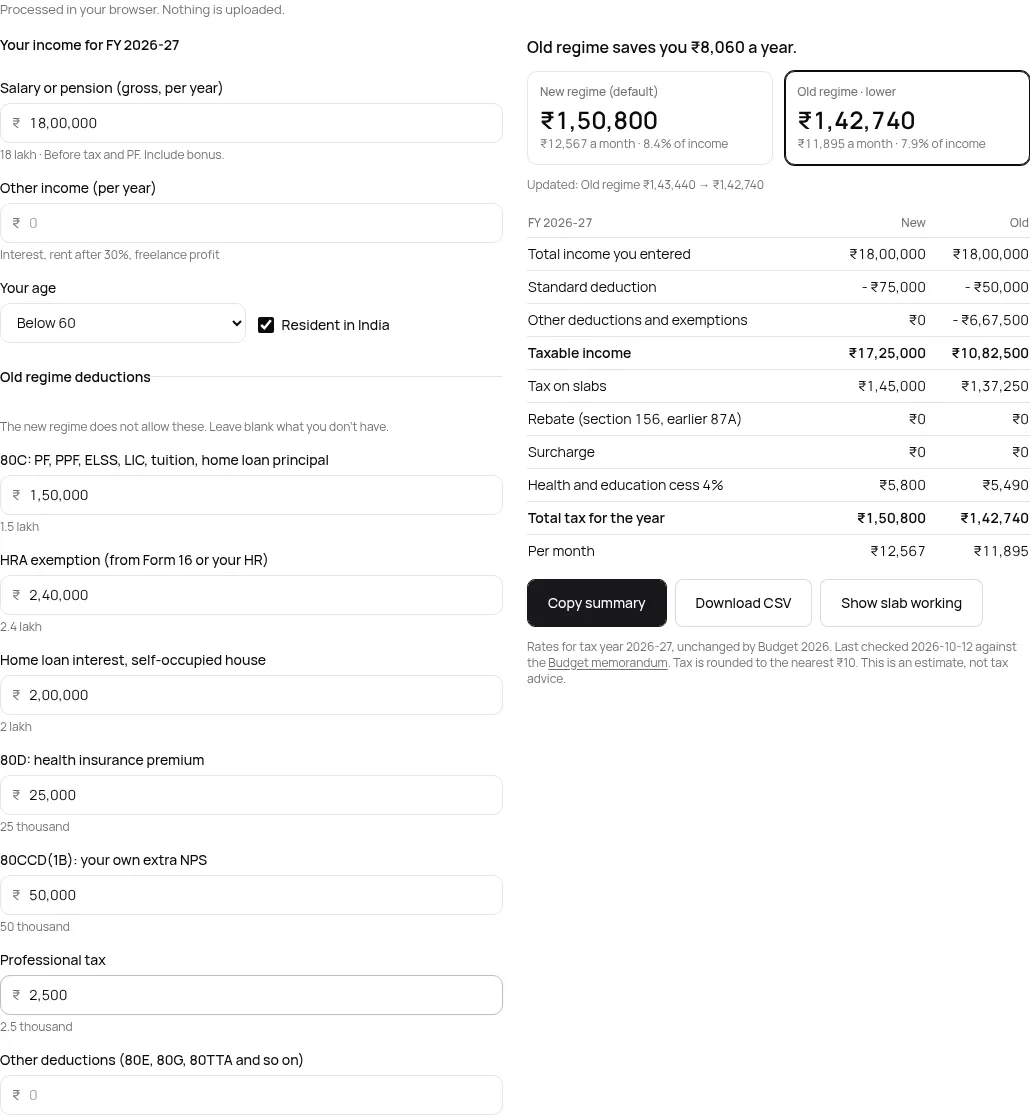
Look at how narrow the old regime's win is. With ₹6.67 lakh of claims at ₹18 lakh, it saves ₹8,060 a year. Drop the home loan from the stack and the new regime is ahead by almost ₹70,000. So the old regime is mostly for people who already have a home loan on a house they live in, pay meaningful rent elsewhere or get HRA, and fill 80C anyway through PF.
A simple way to decide
- Add up what you can really claim, not what you could claim in theory. Your PF contribution counts toward 80C, so many people are already close to ₹1.5 lakh without extra effort.
- Compare that total with the break-even column above for your salary. If you are well short, choose the new regime and stop worrying about tax-saving products.
- If you are close, run your exact numbers in the calculator. It shows both totals and, when the new regime wins, the extra deductions you would need for the old one to catch up.
- Do not buy a product just to save tax. An insurance policy or a lock-in investment you would not otherwise buy can cost more than the tax it saves.
A home loan is often what tips the scale. If you are about to take one, our guide on how to calculate home loan EMI shows how much interest you will pay in the early years, which is the part the old regime lets you deduct.
Switching between regimes
If you only have salary or pension income, you can pick a regime each year when you file. If you have business or professional income, switching is restricted, so take advice before you change. What you tell your employer in April only decides TDS during the year. The return decides the final tax.
FAQ
Is income up to ₹12 lakh tax free in FY 2026-27?
In the new regime, yes, for residents. Taxable income up to ₹12 lakh gets a full rebate. With the ₹75,000 standard deduction, a salary up to ₹12.75 lakh pays no tax.
Did Budget 2026 change the slabs?
No. The Budget 2026 memorandum keeps the rates for tax year 2026-27 as already enacted, in both regimes.
Does age matter?
Only in the old regime. People aged 60 to 79 get a ₹3 lakh nil slab and people 80 and above get ₹5 lakh. The new regime is the same for everyone.
Can I claim home loan interest in the new regime?
Not for a self-occupied house. That is one of the main reasons the old regime can still win for home owners.
Is this calculator official?
No. It follows the official rules linked below and is tested against hand-worked cases, but your Form 16 and the Income Tax Department's e-filing portal are what count. Ask a chartered accountant when in doubt.
Sources
- Budget 2026-27 Memorandum: rates of income-tax for tax year 2026-27 (section 202 and First Schedule Part I-B)
- Finance Bill 2026
- Income-tax Act, 2025, section 19 (standard deduction)
- Income-tax Act, 2025, section 156 (rebate, earlier section 87A)
- Income Tax Department e-filing portal (official tax calculator)
Sources last checked on 13 October 2026. All tax figures above come from the TaskNinja income tax calculator for resident individuals below 60 with salary income.
Written by the TaskNinja team with help from an AI writing tool, then checked against the calculator and the official documents. This is general information, not tax advice.