How to calculate home loan EMI (with prepayment examples)
The EMI formula in plain words, a worked ₹50 lakh example at 8% to 9.5%, and what a ₹2 to ₹10 lakh part-prepayment really saves when you cut tenure or EMI.
Most people find out their EMI from the bank's sanction letter and never look at how it was worked out. That is a pity, because once you see how the number is built, a few decisions get much easier: how long a tenure to take, whether a half percent rate cut matters, and whether that bonus should go into the loan or somewhere else. This guide walks through the maths with real numbers, all taken from our EMI calculator, which runs in your browser and does not upload anything.
The EMI formula, in plain words
Indian home loans use the reducing balance method. The formula is:
EMI = P × r × (1 + r)^n ÷ ((1 + r)^n − 1)
- P is the loan amount, for example ₹50,00,000.
- r is the monthly rate: the yearly rate divided by 12 and by 100. At 8.5% a year, r is 0.0070833.
- n is the number of months. Twenty years is 240.
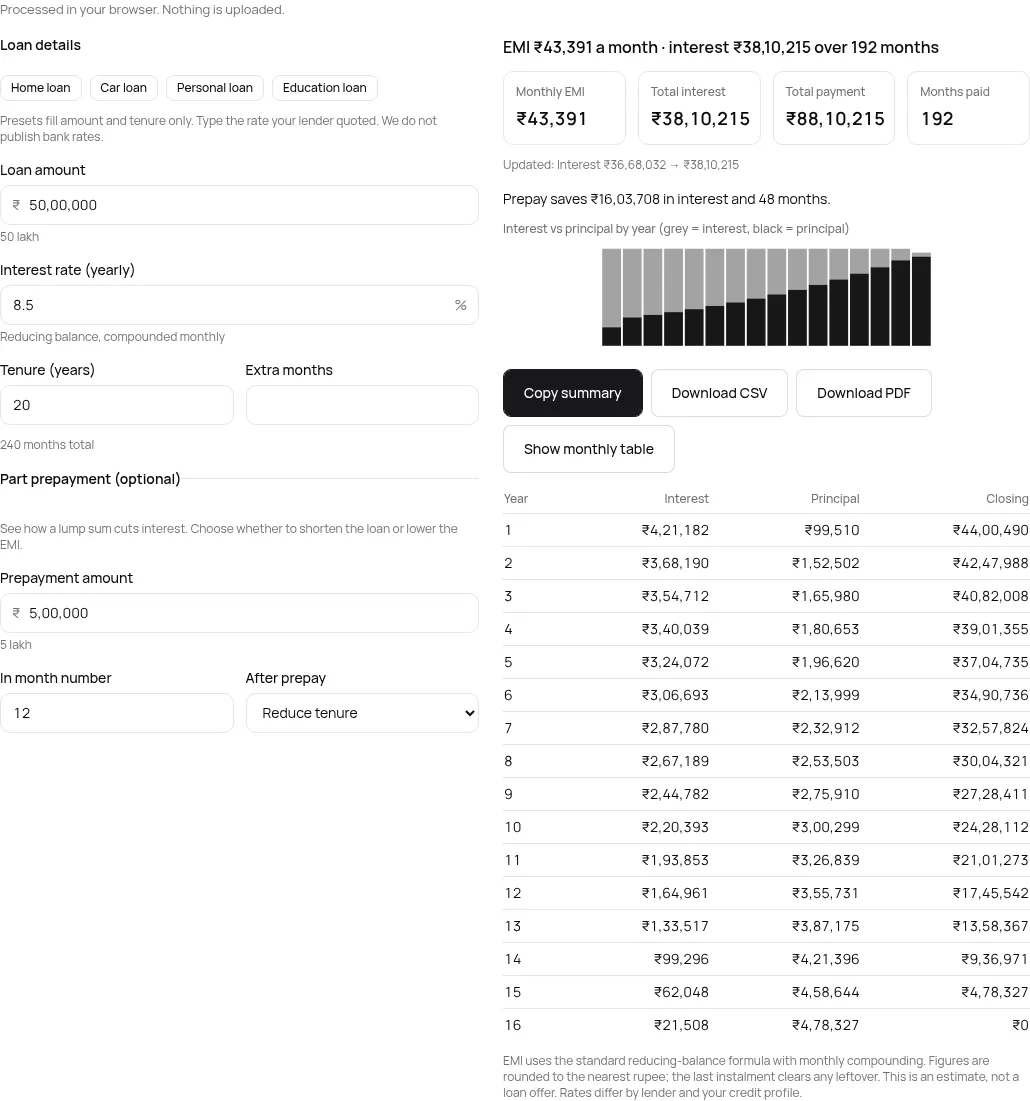
Put those in and you get ₹43,391 a month. Every month, interest is charged only on what you still owe. In month 1 you owe the full ₹50 lakh, so ₹35,417 of your EMI is interest and only ₹7,974 goes to the loan. As the balance falls, the interest part shrinks and the principal part grows, while the EMI stays the same.
That split is the single most useful thing to understand about a home loan. In the first year of this loan you pay ₹5,20,692 in EMIs, and ₹4,21,182 of it is interest. Only ₹99,510 reduces what you owe. By year 10 the split is ₹3,07,420 interest and ₹2,13,272 principal. In the last year almost everything goes to principal.
How the rate changes the EMI
| Rate | Monthly EMI | Total interest | Total paid |
|---|---|---|---|
| 8.0% | ₹41,822 | ₹50,37,289 | ₹1,00,37,289 |
| 8.5% | ₹43,391 | ₹54,13,923 | ₹1,04,13,923 |
| 9.0% | ₹44,986 | ₹57,96,818 | ₹1,07,96,818 |
| 9.5% | ₹46,607 | ₹61,85,377 | ₹1,11,85,377 |
Each half percent adds roughly ₹1,600 to the EMI, which sounds small. Over 20 years it adds about ₹3.8 lakh of interest. That is why it is worth asking your bank to move you to its current rate when rates fall, and why a lower rate at another lender can be worth a balance transfer.
How the tenure changes the EMI
| Tenure | Monthly EMI | Total interest |
|---|---|---|
| 10 years | ₹61,993 | ₹24,39,129 |
| 15 years | ₹49,237 | ₹38,62,648 |
| 20 years | ₹43,391 | ₹54,13,923 |
| 25 years | ₹40,261 | ₹70,78,654 |
Going from 20 to 25 years lowers the EMI by about ₹3,100 but adds more than ₹16.6 lakh of interest. A longer tenure gives you breathing room, and that has real value if your income is uncertain. Just know the price. A common middle path is to take the longer tenure for safety, then prepay whenever you can.
What a part-prepayment actually saves
A part-prepayment is a lump sum paid on top of your EMI. It goes straight to the principal. After it, the bank will either keep your EMI the same and shorten the loan, or keep the end date and lower your EMI. Many lenders default to one or the other, so ask which one they are doing.
| Prepayment | When | Reduce tenure: interest saved | Months saved | Reduce EMI: new EMI | Interest saved |
|---|---|---|---|---|---|
| ₹2 lakh | Month 12 | ₹7,29,417 | 21 | ₹41,620 | ₹2,03,726 |
| ₹5 lakh | Month 12 | ₹16,03,708 | 48 | ₹38,964 | ₹5,09,474 |
| ₹5 lakh | Month 60 | ₹10,69,159 | 36 | ₹38,468 | ₹3,86,385 |
| ₹10 lakh | Month 36 | ₹22,21,891 | 74 | ₹34,108 | ₹8,93,706 |
Three things stand out from this table.
- Reducing tenure saves far more than reducing EMI. The same ₹5 lakh in month 12 saves ₹16 lakh of interest if you keep paying ₹43,391, against about ₹5.1 lakh if you drop the EMI to ₹38,964. With a shorter loan, the money you would have paid in interest during the last four years simply never gets charged.
- Earlier is better. ₹5 lakh paid in month 12 saves ₹16 lakh. The same ₹5 lakh in month 60 saves about ₹10.7 lakh, because by then you have already paid the most interest-heavy years.
- Even small amounts help. ₹2 lakh in the first year takes almost two years off the loan.
Reducing EMI still has its place. If a job change or a new child makes the monthly outgo tight, a lower EMI gives you room without stretching the tenure. It is a cash flow choice, not a savings choice.
Prepayment charges
For a floating rate home loan taken by an individual for a non-business purpose, Indian lenders cannot charge you for prepaying. The RBI's Pre-payment Charges on Loans Directions, 2025 say this applies to part or full prepayment, from any source of funds, without a lock-in, for loans sanctioned or renewed from 1 January 2026. Older floating rate home loans were already covered by earlier RBI circulars. Fixed rate loans can still carry a charge, so read your sanction letter or Key Facts Statement before you pay.
Should you prepay at all?
Prepaying is a guaranteed return equal to your loan rate, after tax. At 8.5% that is a decent, risk-free return. A few things to weigh before you send the money:
- Keep an emergency fund first. Money paid into a loan is hard to get back.
- Check your tax. In the old tax regime, home loan interest on a self-occupied house is deductible up to ₹2 lakh a year, and principal counts toward 80C. In the new regime, neither applies to a self-occupied home. Our income tax calculator shows whether those deductions change which regime suits you. We wrote up the details in Old vs new tax regime FY 2026-27.
- Compare with what else you could earn. If you expect a clearly higher return elsewhere and are comfortable with the risk, investing can win. Many people split the difference.
Work out your own numbers
- Open the EMI calculator and pick Home loan, or type your amount.
- Enter the rate your lender quoted and the tenure in years.
- Under Part prepayment, enter an amount and the month you expect to pay it.
- Switch between Reduce tenure and Reduce EMI and compare the savings line.
- Download the CSV or PDF schedule if you want to check it against your bank statement.
Your bank's numbers may differ by a few rupees. Some lenders charge interest daily, round differently, or start with a broken period interest for the first part month. The calculator is an estimate, not a loan offer.
FAQ
Does the EMI change when the repo rate changes?
For a floating rate loan linked to an external benchmark, yes, the rate resets. Many banks keep the EMI and stretch the tenure instead. RBI rules say the lender must tell you and offer the choice of a higher EMI, a longer tenure, a mix, or prepayment.
Is it better to prepay or invest?
Prepaying gives a certain return equal to your loan rate. Investing might give more or less. If the loan rate is high and you dislike risk, prepaying usually makes sense once your emergency fund is in place.
Can I prepay every year?
Yes. Each prepayment reduces the principal from that point. Try two or three amounts in the calculator one at a time to see the effect.
Why does my bank's EMI differ slightly?
Differences in rounding, daily versus monthly interest, and a first part month of interest can move the EMI by a few rupees. Your loan account statement is the final word.
Sources
- RBI (Pre-payment Charges on Loans) Directions, 2025
- RBI circular: Reset of floating interest rate on EMI based personal loans, 18 August 2023
- RBI FAQs on the EMI reset circular
Sources last checked on 13 October 2026. All figures in the tables come from the TaskNinja EMI calculator, which is tested against the standard EMI formula.
Written by the TaskNinja team with help from an AI writing tool, then checked against the calculator and the RBI documents. This is general information, not financial advice.