FD monthly interest: what ₹5 lakh, ₹10 lakh or ₹40 lakh pays you each month
How much a fixed deposit pays every month, with a table from ₹1 lakh to ₹1 crore, why banks pay a bit less than rate ÷ 12, and how TDS and Form 121 work.
At 7% a year, a fixed deposit with monthly payout pays about ₹580 a month for every ₹1 lakh. So ₹5 lakh pays about ₹2,900 a month, ₹10 lakh about ₹5,799 and ₹40 lakh about ₹23,198, before tax. You can check your own amount and rate in the free FD Calculator, which works it out the way Indian banks do.
If you divided 7% by 12 you would expect ₹583 per lakh, not ₹580. That small gap confuses a lot of people, and it adds up on a big deposit. Below is a table for common amounts, the reason for the gap, a comparison with quarterly and cumulative FDs, and what TDS does to the cheque that actually reaches your account.
Monthly interest on common FD amounts
We ran each amount through the FD Calculator on 17 Nov 2026 for a one year deposit. The 7% column is a typical rate for regular depositors and 7.5% a typical senior citizen rate. Your bank's rate card will differ, so treat these as a guide and type your own rate for the real figure.
| Deposit | At 7% a year | At 7.5% a year | Interest in a year at 7% |
|---|---|---|---|
| ₹1,00,000 | ₹580 (₹583) | ₹621 (₹625) | ₹6,960 |
| ₹5,00,000 | ₹2,900 (₹2,917) | ₹3,106 (₹3,125) | ₹34,800 |
| ₹10,00,000 | ₹5,799 (₹5,833) | ₹6,211 (₹6,250) | ₹69,588 |
| ₹20,00,000 | ₹11,599 (₹11,667) | ₹12,422 (₹12,500) | ₹1,39,188 |
| ₹25,00,000 | ₹14,499 (₹14,583) | ₹15,528 (₹15,625) | ₹1,73,988 |
| ₹40,00,000 | ₹23,198 (₹23,333) | ₹24,844 (₹25,000) | ₹2,78,376 |
| ₹50,00,000 | ₹28,997 (₹29,167) | ₹31,055 (₹31,250) | ₹3,47,964 |
| ₹1,00,00,000 | ₹57,994 (₹58,333) | ₹62,111 (₹62,500) | ₹6,95,928 |
The figures scale almost exactly with the deposit, so for an amount that is not in the table, multiply the ₹1 lakh line. ₹15 lakh at 7% is about 15 × ₹580 = ₹8,700 a month.
Why monthly interest is less than rate ÷ 12
Indian banks work out term deposit interest every quarter. The Reserve Bank of India's FAQ on deposits says interest on term deposits is payable at quarterly or longer rests, and that in monthly schemes "the interest is calculated for the quarter and may be paid monthly at the discounted value".
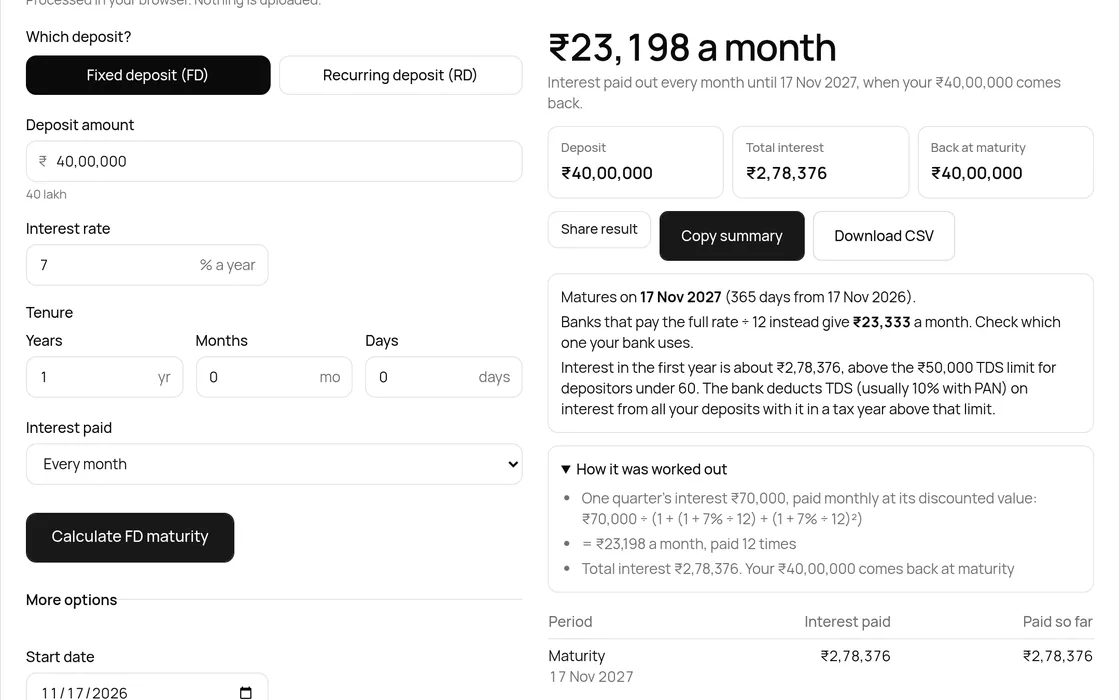
Here is what that means for ₹40 lakh at 7%. One quarter's interest is ₹40,00,000 × 7% ÷ 4 = ₹70,000. If the bank paid it all at the end of the quarter, you would get ₹70,000 every three months. Paying it monthly means you get the money one or two months early, so the bank pays a slightly smaller amount that, had you put each payment back at 7%, would grow to exactly ₹70,000 by the quarter end:
- Monthly rate m = 7% ÷ 12 = 0.5833%
- Monthly payment = ₹70,000 ÷ (1 + (1 + m) + (1 + m)²) = ₹23,198
- Rate ÷ 12 would give ₹40,00,000 × 7% ÷ 12 = ₹23,333
The difference is ₹135 a month, or about ₹1,620 over a year on ₹40 lakh. You are not being short changed; you simply receive the money sooner. Some banks do pay the plain rate ÷ 12 figure, so the calculator shows both and you can match whichever your bank's receipt shows.
Monthly, quarterly or cumulative?
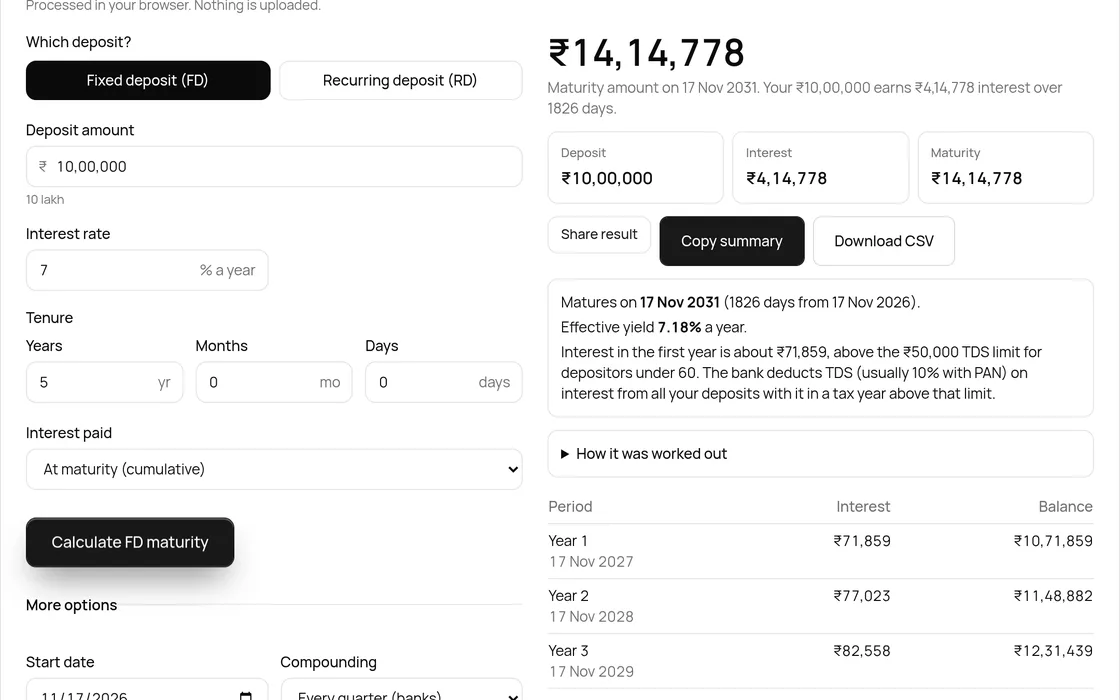
The same deposit can pay out monthly, pay out quarterly, or keep its interest and pay everything at maturity (a cumulative or reinvestment FD). For ₹10 lakh at 7% over 5 years, the calculator gives:
| Interest paid | You receive | Total interest | At maturity |
|---|---|---|---|
| Every month | ₹5,799 a month, 60 times | ₹3,47,940 | ₹10,00,000 back |
| Every quarter | ₹17,500 a quarter, 20 times | ₹3,50,000 | ₹10,00,000 back |
| At maturity (cumulative) | Nothing until the end | ₹4,14,778 | ₹14,14,778 |
Monthly and quarterly payout end up almost level, because the monthly figure is designed to be worth the same as the quarterly one. Cumulative earns about ₹65,000 more, because each quarter's interest is added to the deposit and earns interest itself. That works out to an effective yield of 7.18% a year on a 7% card rate.
So which one? If you need the money to pay bills, such as a retired parent covering household costs, monthly payout is the right tool and the small discount is the price of getting paid early. If you do not need the income now, the cumulative FD earns more. Quarterly payout suits people who are fine with a payment every three months and want the round figure.
Check your own figure in 30 seconds
- Open the FD Calculator. Fixed deposit is already selected.
- Type the deposit, for example 40,00,000, and the rate from your bank's current rate card, for example 7.
- Type the tenure in years, months and days. Odd tenures like 444 days work too.
- Set Interest paid to Every month (or Every quarter) and tap Calculate FD maturity.
- Read the monthly figure at the top. Open How it was worked out to see the formula, and tick the senior citizen box under More options if you are 60 or older.
Everything is worked out in your browser. The amounts you type are not sent anywhere, which is nice when the number is your retirement corpus.
What TDS does to your monthly payment
FD interest is taxable as your income. Under section 393 of the Income-tax Act, 2025, a bank deducts tax at source (TDS) when the interest it pays you in a tax year crosses ₹50,000, or ₹1,00,000 if you are a senior citizen. The usual rate is 10% if the bank has your PAN, and higher if it does not. The limit is per bank and counts all your deposits with that bank together.
On ₹10 lakh at 7% the year's interest is ₹69,588, so a depositor under 60 crosses the limit and a senior citizen does not. On ₹40 lakh the interest is ₹2,78,376, above both limits. TDS of 10% is then about ₹27,838 for the year, which takes a ₹23,198 monthly payment down to roughly ₹20,878 once deductions start. Banks differ in exactly when in the year they start deducting, so look at your passbook for the first few months.
TDS is not the final tax. Your interest is added to your other income and taxed at your slab rate in your return, and TDS already cut is credited against it. Our income tax calculator and the guide to the old and new tax regimes help you see the real figure.
Form 121 replaced Form 15G and 15H
If the tax on your total income for the year will be nil, you can ask the bank not to deduct TDS. From 1 April 2026 you do this with Form 121, a single form under section 393(6) of the new Act that replaced Form 15G (under 60) and Form 15H (60 and above). Give it to each bank at the start of the tax year, or when you open a new FD, because TDS already deducted before you submit it is not reversed by the bank. You would then claim it back as a refund in your return.
A word on very large deposits
Deposit insurance from DICGC, a subsidiary of the RBI, covers up to ₹5 lakh per depositor per bank, principal and interest together, and deposits in different branches of the same bank are added up. A ₹40 lakh FD in one bank is mostly above that cover. Many people with large sums split them across a few banks, which also spreads the TDS limit. That is a personal choice, but it is worth knowing before you put a retirement lump sum in one place.
FAQ
How much monthly interest will I get on a ₹10 lakh FD?
At 7% a year, about ₹5,799 a month with the discounted monthly method most banks use, or ₹5,833 if your bank pays the plain rate ÷ 12. At 7.5% it is about ₹6,211. Use the FD Calculator with your bank's exact rate.
What is the interest per month on a ₹40 lakh FD?
About ₹23,198 a month at 7% and ₹24,844 at 7.5%, before tax. After 10% TDS, the amount credited is roughly ₹20,878 at 7%.
Is monthly payout or cumulative FD better?
Cumulative earns more because interest compounds every quarter, about ₹65,000 more on ₹10 lakh over 5 years at 7%. Monthly payout is better only if you need regular income now.
Do senior citizens get more monthly interest?
Most banks pay depositors aged 60 and above a slightly higher rate, shown as a separate senior citizen column on the rate card, so the monthly payment is a little higher. Seniors also get a higher TDS limit of ₹1,00,000 a year per bank.
Can I avoid TDS on FD interest?
Only if the tax on your total income for the year is nil. Then you can submit Form 121 (which replaced Form 15G and 15H from 1 April 2026) to the bank. Otherwise TDS is deducted, and you settle the final tax in your return.
Sources
- Reserve Bank of India: FAQs on banking matters, domestic deposits (term deposit interest at quarterly or longer rests; monthly schemes paid at the discounted value)
- SBI deposit rates page (method of calculation, quarterly compounding)
- Income Tax Department: section 393 of the Income-tax Act, 2025 (TDS on deposit interest above ₹50,000, ₹1,00,000 for senior citizens)
- Income Tax Department: Form No. 121 FAQs (Form 121 replaces Form 15G and 15H under section 393(6))
- DICGC: A guide to deposit insurance (₹5 lakh per depositor per bank, principal and interest)
- Every amount above was calculated on the live FD Calculator on 17 Nov 2026, start date 17 Nov 2026
Written by the TaskNinja team with help from an AI writing tool, then checked against the live FD Calculator. This is general information, not tax or investment advice.